
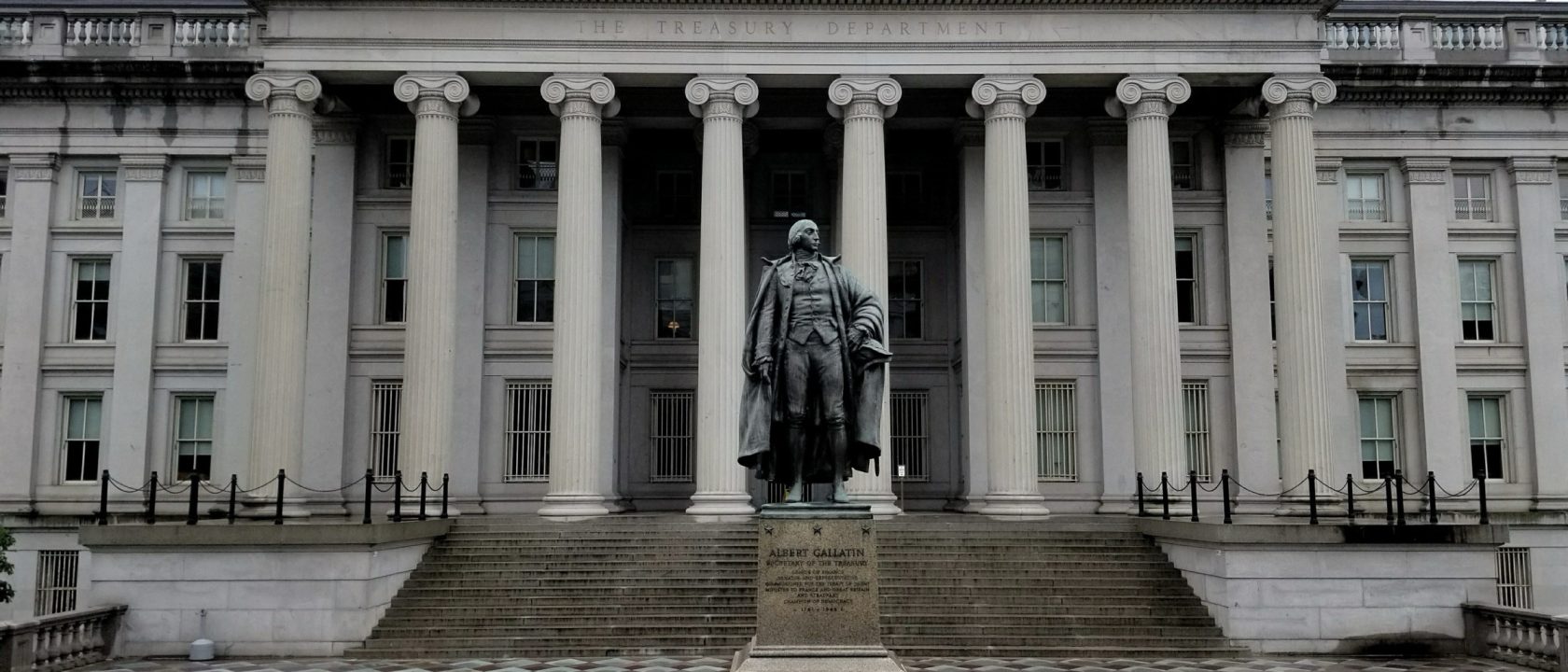
The federal government had $972 billion of borrowing room left under the statutory debt limit at the close of business on October 14, according to the Daily Treasury Statement. The limit stands at $41.104 trillion, set when Congress added $5 trillion in the July 2025 reconciliation law. Debt subject to that limit was $40.132 trillion.
That is less than half a year of borrowing at the recent pace. The Bipartisan Policy Center expects the limit to bind sometime between late winter and mid-summer 2027, which would hand the newly elected 120th Congress a default deadline within its first months. The midterms will decide who negotiates it.
1. Reading the Treasury’s ledger
Two debt numbers circulate, and they are easy to mix up. Total public debt outstanding, the headline “Debt to the Penny” figure, was $40.329 trillion on October 14. It first crossed $40 trillion on August 18, 2026. The debt limit applies to a slightly smaller measure that excludes unamortized discount and a few other items.
| Line (Oct. 14, 2026) | Amount |
|---|---|
| Debt held by the public | $32.484T |
| Intragovernmental holdings | $7.846T |
| Less: debt not subject to limit | −$0.198T |
| Debt subject to limit | $40.132T |
| Statutory debt limit | $41.104T |
| Remaining headroom | $0.972T |
2. How fast the room is going
Total public debt rose $2.41 trillion over the twelve months to October 14, about $200 billion a month. The pace has not been even. In each of the quarters ending January, April and July 2026 the debt grew by roughly $480 billion to $540 billion. In the quarter ending October 14 it grew by about $860 billion.
Part of that late surge is cash management, not deficits. Treasury told markets in August that it assumed a $950 billion cash balance at the end of September and expected the Treasury General Account to peak near $1.05 trillion in late October ahead of large outflows. Borrowing to fill the account counts against the limit just like borrowing to pay bills. Tariff refunds, which Customs began paying in May after the Supreme Court struck down the IEEPA tariffs, also pulled borrowing forward.
At $200 billion a month, $972 billion lasts about five months. April tax receipts are the main reason that estimate stretches.
A straight-line projection at $200 billion a month runs out of room around March 2027. That is too simple. April individual tax payments usually shrink borrowing for several weeks, and a drawdown of the swollen cash balance could slow new issuance. Those factors push the date later, which is why BPC’s window runs from late winter into mid-summer.
3. What happens when the limit binds
Hitting the limit is not default. Treasury would declare a debt issuance suspension period and use “extraordinary measures,” accounting maneuvers such as suspending investments in certain federal employee retirement funds, along with its cash on hand. BPC estimates those resources would last roughly six to nine months. Only after that, at the so-called X date, would the government be unable to pay all its obligations on time.
Stacking the two windows puts a plausible X date somewhere from late 2027 into early 2028. That is a wide range, and BPC flags two variables that could move it.
- Tariff revenue and refunds. In the 2025 debt-limit episode, tariff collections were a meaningful source of cash. That cushion is smaller now that IEEPA duties have been struck down and up to $166 billion, plus interest, is being returned.
- Defense spending. The administration’s FY2027 request included a large increase in defense spending, and BPC notes that conflict-related costs could raise outlays. A supplemental appropriation would bring the date forward.
4. The politics of the next round
The last increase rode through Congress inside a party-line reconciliation bill, which needs only a simple majority in the Senate. Republicans can use that path again only if they hold both chambers and adopt a new budget resolution with debt-limit instructions. If the midterms split control, the limit returns to regular order, where it needs 60 Senate votes or a bipartisan deal.
Democrats have pushed to take the issue off the table; Sen. Elizabeth Warren called in July for bipartisan action to eliminate the debt limit. Republicans have generally preferred to pair increases with spending policy. Neither position has the votes to settle the question permanently. The likelier reading is another increase, sized to carry past the 2028 election, negotiated under deadline pressure.
5. What to watch
- November 4: Treasury’s quarterly refunding announcement, with updated borrowing estimates and cash-balance assumptions.
- December 11: The stopgap funding law expires. A full-year deal with higher defense spending would speed up borrowing.
- January 3, 2027: The 120th Congress convenes. Watch whether the majority writes a debt-limit increase into a new budget resolution.
- Daily: Table III-C of the Daily Treasury Statement is the scoreboard. Headroom under about $300 billion means the limit is weeks away.
- Daily Treasury Statement, Table III-C: Debt Subject to Limit — U.S. Treasury, Fiscal Data · fiscaldata.treasury.gov
- Debt to the Penny — U.S. Treasury, Fiscal Data · fiscaldata.treasury.gov
- When Will We Reach the Debt Limit (Again)? — Bipartisan Policy Center · bipartisanpolicy.org
- Quarterly Refunding Statement, August 5, 2026 — U.S. Department of the Treasury · home.treasury.gov
- H.R. 1, One Big Beautiful Bill Act (P.L. 119-21) — Congress.gov · congress.gov
gov.house is independent and is not affiliated with any government body. This file is journalism, not investment, tax or legal advice. How we work: ethics & standards · Spotted an error? Corrections.